Child protection systems are essential, yet they are often poorly defined within national policy frameworks
Child protection systems are being embedded in international development and humanitarian discourse. They appear in global strategies, donor frameworks, national action plans, and UN commitments. Yet, despite this progress, child protection still lacks something fundamental: a shared, operational understanding of what a child protection system actually is.
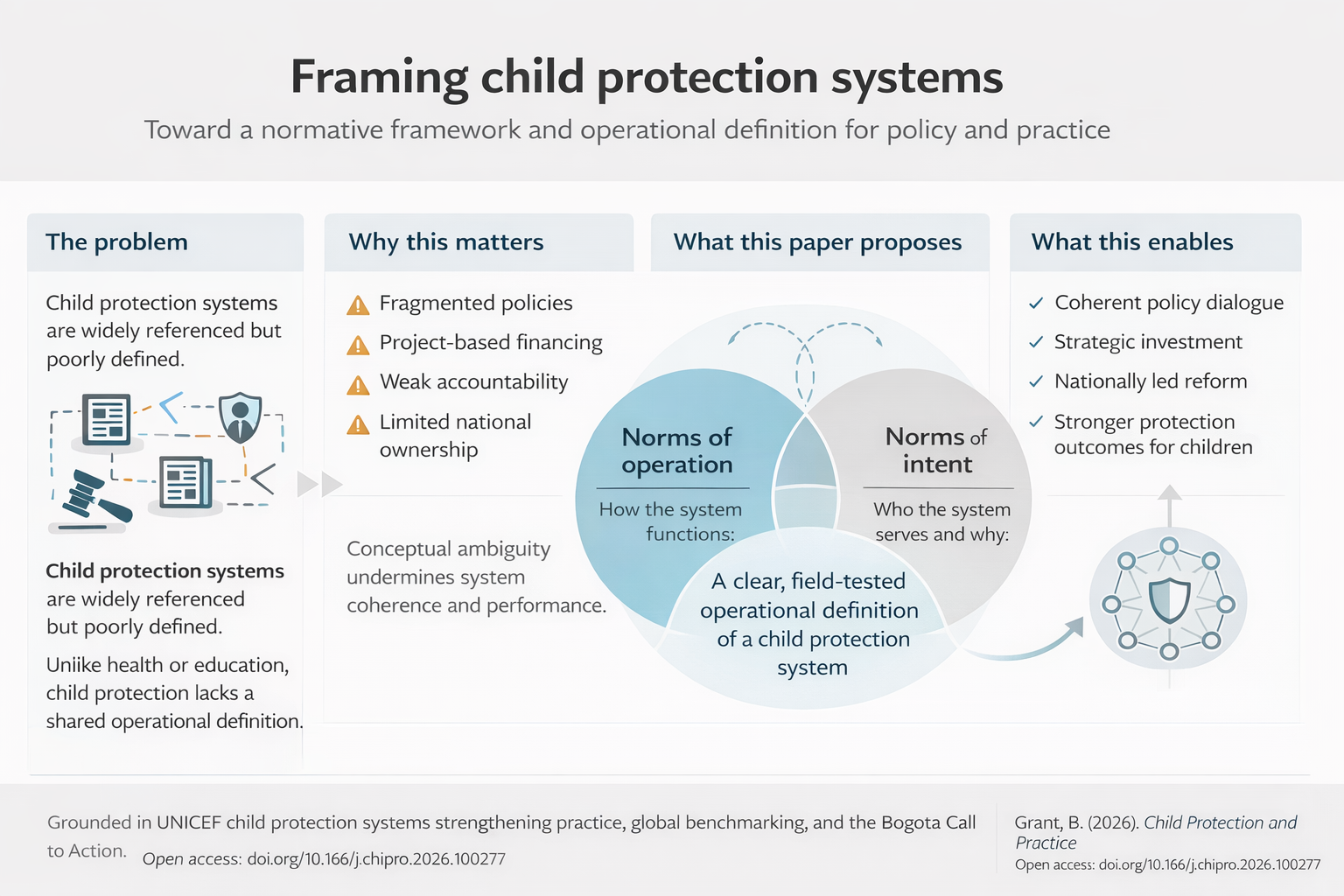
This gap matters more than we often acknowledge
Unlike sectors such as health or education, child protection has struggled to translate normative commitments into coherent, system-level policy and investment. The result is familiar to many practitioners: fragmented programmes, uneven coverage, short-term projects, and limited national ownership. Too often, systems language is used rhetorically, while practice remains piecemeal.
My recent paper, published in Child Protection and Practice, argues that this problem is not primarily technical. It is conceptual.

The problem is not a lack of models
Over the past two decades, the field has produced a wide range of approaches to child protection. These include statutory and justice-led models, welfare and public health approaches, community-based and community-led mechanisms, civil society-led initiatives, and humanitarian and migration-sensitive systems. Each has emerged in response to particular political, social, and institutional contexts.
The problem is not that these approaches exist. Nor is it that one model has “won” over others. In practice, most countries operate hybrid systems that draw on several traditions at once.
The deeper issue is that these typologies have not been anchored in a shared normative framework. As a result, debates about child protection systems often slide into false binaries: formal versus informal, statutory versus community-based, prevention versus response. These distinctions obscure more than they reveal, and they make it harder to assess whether systems are actually working for children.
Why child protection still lags behind other sectors
Health and education systems benefit from relatively clear conceptual boundaries. Even where delivery is uneven, there is broad agreement on what constitutes a health system or an education system, what governments are responsible for, and how performance should be assessed.
Child protection does not yet enjoy the same clarity. This has consequences. Conceptual ambiguity weakens policy coherence, complicates financing decisions, and makes accountability difficult. It also allows system reform to be interpreted narrowly, sometimes reduced to the expansion of services or the adoption of isolated tools, rather than understood as a governance challenge.
A normative framework for child protection systems
The paper proposes a way forward by distinguishing between two sets of shared norms that should underpin all child protection systems, regardless of context.
First, norms of operation. These relate to how systems function in practice. They include governance arrangements, the availability and quality of services, the capacity of the workforce, information and data systems, and sustainable financing. Without attention to these operational foundations, systems remain fragile and dependent on external actors.
Second, norms of intent. These relate to who systems are for and what they seek to achieve. They include alignment with child rights, attention to vulnerability and inequality, and a commitment to both prevention and response. These norms help guard against systems that are procedurally functional but substantively unjust.
Taken together, these norms provide a basis for assessing very different system configurations without imposing a single model or pathway.
An expanded operational definition
Building on this framework, the paper offers an expanded, field-tested operational definition of child protection systems. The aim is not to introduce a new model or replace existing approaches. Rather, it is to provide clearer conceptual grounding that can support policy dialogue, internal alignment within organisations, and more strategic decision-making on systems-level investment.
This matters particularly in contexts affected by conflict, displacement, and institutional fragility, where parallel systems often emerge and where questions of national ownership and sustainability are most acute.
Why this matters now
Recent global milestones, including the Bogotá Call to Action, reflect growing recognition that child protection systems strengthening is a political and governance challenge, not just a technical one. At the same time, financial constraints and shifting donor priorities make it even more important to invest wisely and coherently.
Clarity will not solve all the challenges facing child protection. But without clarity, those challenges become harder to address.
If child protection is to be treated as a core pillar of international development, rather than a residual concern, it needs the same conceptual discipline we expect of other sectors.
Read the paper
The full paper is open access and available here:
Grant, B. (2026). Framing child protection systems: Toward a normative framework and operational definition for policy and practice. Child Protection and Practice.